Book Thoughts: How to Hide an Empire by Daniel Immerwahr
This book is focused on illuminating the U.S.'s empire across its history, going from what Immerwahr calls the Colonialist Empire to the Pointillist Empire. Basically, over time, the U.S. has decided it doesn't need to control much land because technology has improved to let them control things from a series of points, AKA our 800 military bases overseas.
Puerto Rico might be more visible in the average American's knowledge now (one hopes), but what about how entangled the U.S. was in the Philippines, to the point that it was actually on the maps in the 1900s? What about the fact that Alaska and Hawai'i didn't become states until after WWII, and they were legitimately just seen as colonies? And all of the failed proposed states because the U.S. was too racist to consider letting in any territory that was majority people of color? And what about all the islands, a total of like 4 million people, that don't have any representation now, where basically the military gets to rule?
Given its scope, this book is focused on the concept of territory; it's basically about military and its atrocities. And yet, there's a lot of other stuff missing because the list of U.S. crimes (such as every coup attempted by the CIA) are too long to even really cover. Nearly every historical figure in this book mentioned is a man because of this.
The book is easier to read than a completely dry history textbook because it starts every section with talking about a work or a person that sets the scene for the actual history part. This is a really useful technique that I don't think I appreciated when I was younger (since I was only trying to look for facts), because it helps you remember where things are placed a little bit better. That said, I would have appreciated a timeline of all of the events mentioned in this book at the end because the narrative loops back and forth.
Main thoughts I have from all of this is:
- JFC
- Wow even "Pearl Harbor" is a misrepresentation because it's like "Pearl Harbor and all of our territories we're not mentioning."
- bird poop...
- Teddy Roosevelt in high contending for one of the evil U.S. presidents ever?
- The number of times the U.S. has used concentration camps?????????????????????????/
- We did WHAT in the Philippines???
- "Rules for thee and not for me" might as well be the actual national anthem given the sheer military excess, suppression of rights for anyone who isn't a white mainlander, and given Albizu & Ho Chi Minh, who really wanted to believe Woodrow Wilson's League of Nations only to be sorely disappointed & then raised opposition armies to U.S. occupancy. See also Aguinaldo
- For all of people who claim technology lowers inequality or whatever just look at every tech that has been invented by war and coerced test subjects
Also I think Immerwahr's favorite historical figure (because he's neglected) is Albizu and it's like his mission to get this guy into history textbooks.
Below are some basic notes I took throughout the book.
"Pearl Harbor" attacks were also on a lot of U.S. territories at the time (biggest being the Philippines), yet they weren't mentioned in FDR's speech; what counts as the U.S.?
- Hawaii had more white people & closer.
- Even the date (Dec 7) reflects Hawaii & Midlands rather than the 8th, which JPN uses for most of the attacks
Likewise, people didn't care much about the al-Qaeda attacks on U.S. embassies in various African countries 3 years before, only about the Sept 11
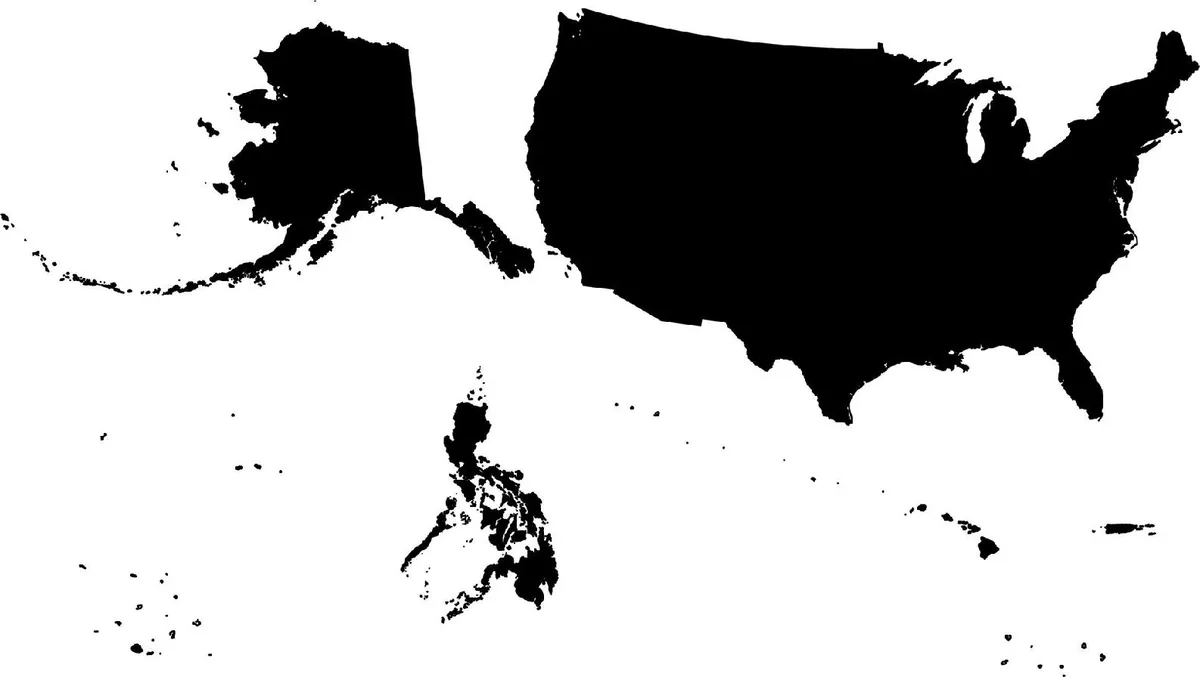 The Greater United States, 1941: (Top row, from left) Alaska, the mainland; (middle row) Guam, American Samoa, the Philippines, Hawai‘i, Puerto Rico, and the U.S. Virgin Islands; (bottom row, and not to scale) the Pacific outlying islands (left) and the Caribbean outlying islands (right)
From the day the treaty securing independence from Britain was ratified, right up to the present, it’s been a collection of states and territories. It’s been a partitioned country, divided into two sections, with different laws applying in each.
What getting the Greater United States in view reveals is that race has been even more central to U.S. history than is usually supposed. It hasn’t just been about black and white, but about Filipino, Hawaiian, Samoan, and Chamoru (from Guam), too, among other identities. Race has not only shaped lives, it’s shaped the country itself—where the borders went, who has counted as “American.”
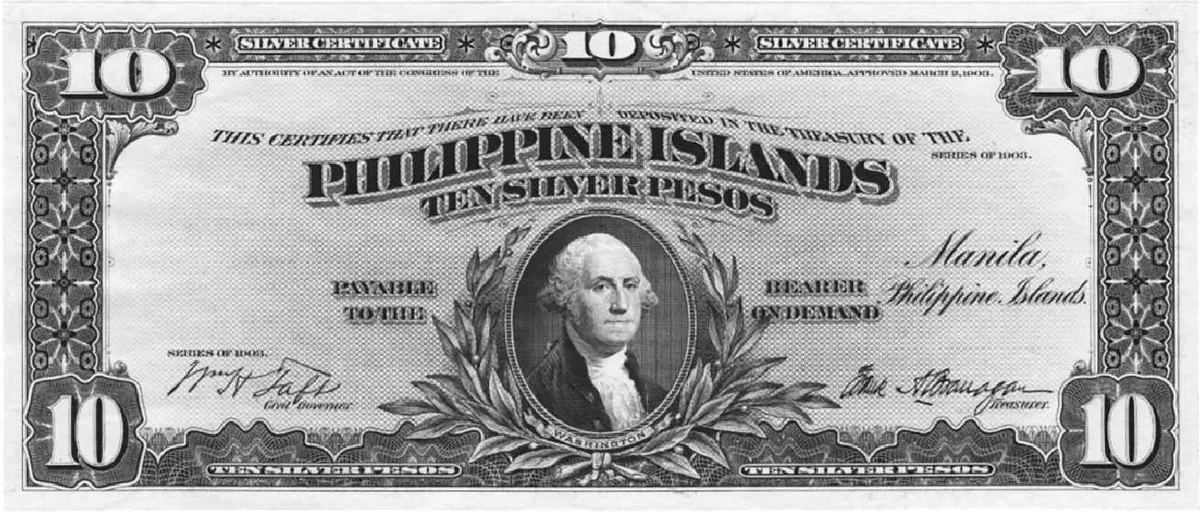
"Philippine Islands, U.S.A.: A ten-peso note. Throughout the territories, colonized subjects were obliged to use bills with the faces of U.S. leaders on them. Extraordinarily, this Philippine bill was the basis for the design of the familiar U.S. dollar, not the other way around."
Besides Guam, American Samoa, the Northern Mariana Islands, Puerto Rico, the U.S. Virgin Islands, and a handful of minor outlying islands, the United States maintains roughly eight hundred overseas military bases around the world.
- The U.S. has always been a collection of states and territories: the first territories were westward of the original states and controlled by the government. The gov refused multiple of these territories' bids to become states in the beginning until the population of "white savages" greatly outpaced what was expected, at which point they were branded "pioneers" and given statehood much faster
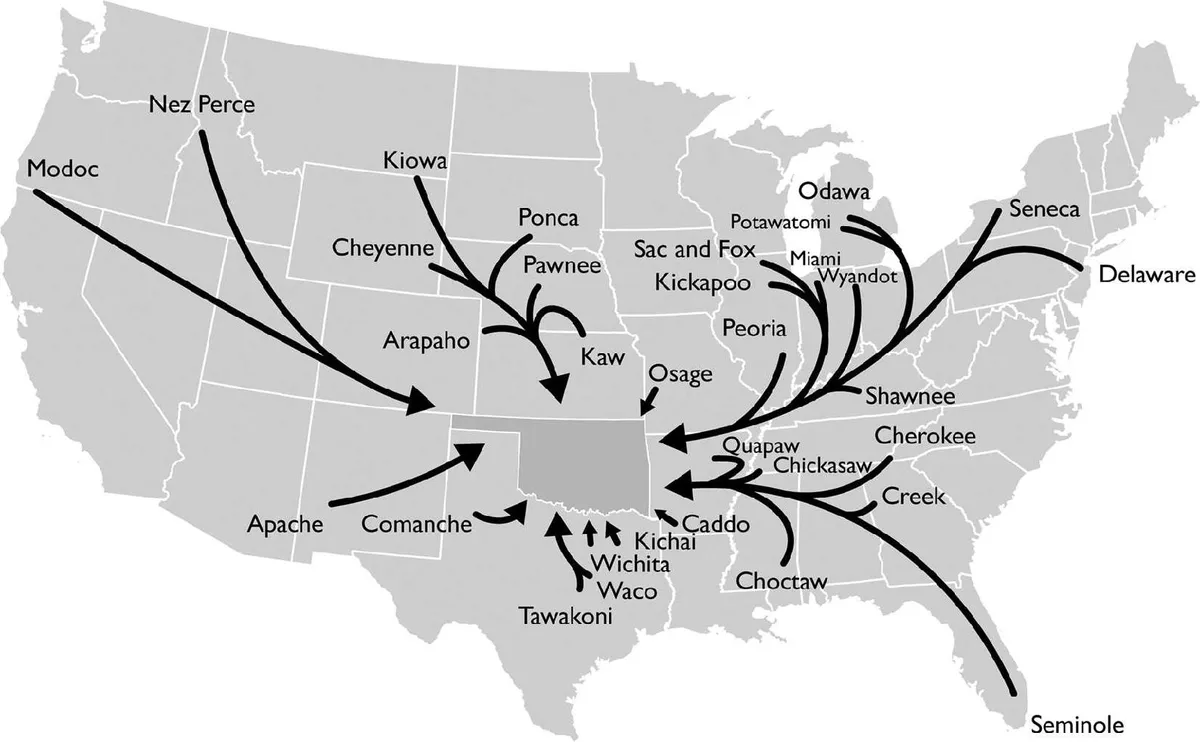
Map of forcing indigenous groups into Oklahoma
- Indigenous tribes tried to make the state of Sequoyah, after the silversmith who had designed the Cherokee syllabary. Congress said no and made Oklahoma (according to settlers) a state
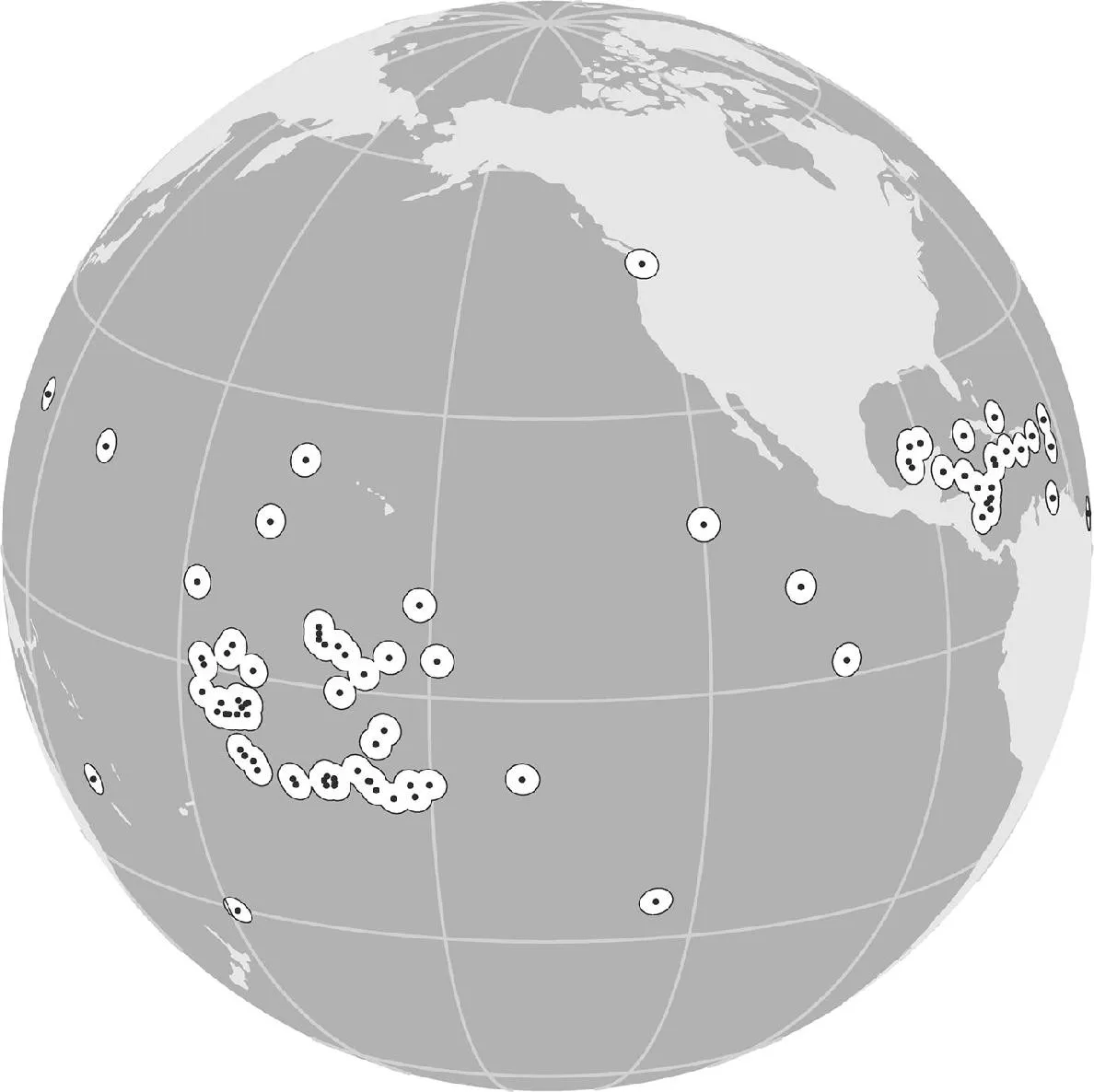 U.S. guano island claims, 1857–1902
- All this stuff about guano. Wow bird poop is valuable. Wow the U.S. grabbed all these islands in the Pacific for this stuff. Also all the abuse workers were put through to get this stuff. The Navassa Island (coral deposits) & the workers' rights case that confirmed that these islands were claimed by the U.S. Didn't realize how important nitrogen is and how much of a limiter on food it was (solved by Fritz Haber, who then went on to make poison gas)
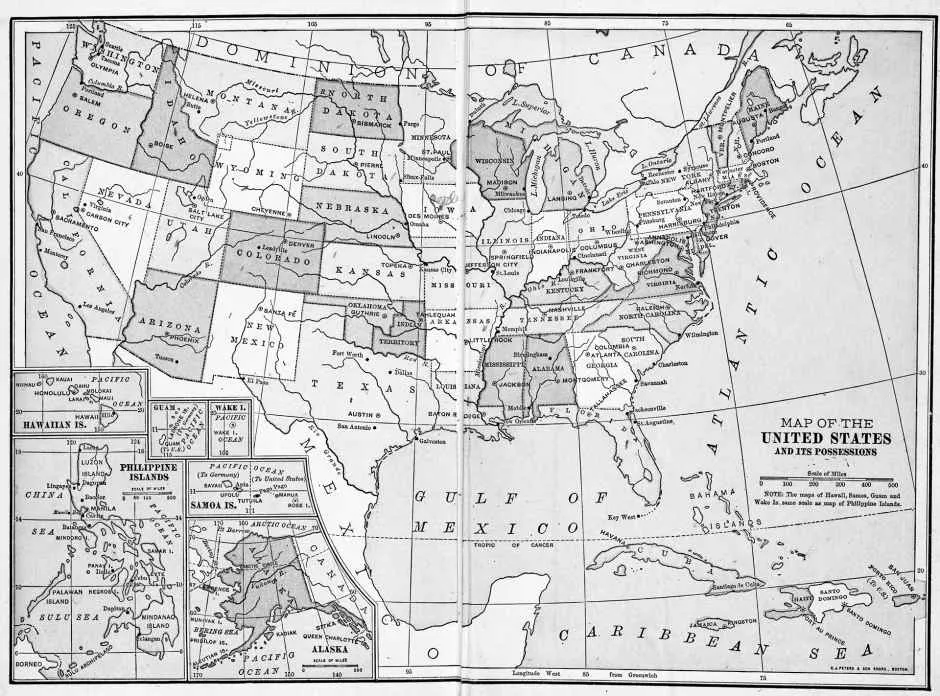
The Greater United States: Maps like this, taken from the inside cover of a 1900 history textbook, appeared frequently starting in 1899, often as the principal maps of the United States. Shown, along with the states, are a much-diminished Indian Country, as well as Hawai‘i, Guam, Wake, American Samoa, the Philippines, Alaska, Cuba, and Puerto Rico.
1898 "Columbia"/"United States" -> "America" linguistic switch
before 1898 the U.S. specifically avoided annexing territories with high nonwhite populations. such as letting Southern Mexico go. didn't want the people. refused to take Nicaragua or the Dominican Republic.
Refused to count indigenous people in censuses until 1880 (Alaska) & 1890 (mainland) and only did so in a segregated manner.
Kind of surprising how readily the N-word was used for all brown people the whites didn't want. Like Filipinos were also referred to with this word. A lot.
Hawaii was taken for military purposes.
Good god Teddy Roosevelt was a flaming racist esp towards Indigenous peoples. and people love him as a president. bleurgh
1901 Insular Cases that determined some parts of the country (territories) do not have to follow the Bill of Rights; main reasoning is race. Their citizenship is statutory and can be revoked; they get no political representation
- There's a chapter on the US-Filipino war and how Aguinaldo tried to bank on the U.S. election going to anti-imperialists, but it didn't work out. The U.S. made concentration camps just like Spain did in Cuba (which was their purported reason for getting involved there before)
The fantasy of conquest is always the same: defeat the leader and the country is yours. The United States had learned the folly of this when it won the Philippines from Spain, only to find itself fighting the Philippine Army. It was about to learn the lesson again.
Filipino nationalists also used terror tactics to keep up support for the fight against the U.S. (who were expanding murder, concentration camps, and torture as their stick - they also built some public works as the carrot). war is hell
Dying from disease is a large part of warfare (or at least it was in the 1900s)
The total population death toll was like 1/6 on Luzon
Massacre of Moros at Bud Dajo
Every one of the army’s first twelve chiefs of staff, in fact, served in the Philippine War. Stretching from the outbreak of hostilities in 1899 to the end of military rule in Moroland in 1913, it is, after the war in Afghanistan, the longest war the United States has ever fought.
violating human life & making concentration camps gets you a high position in the military. ugh
The ploy was used repeatedly, in country after country around the Caribbean. The United States seized the levers of finance and trade but left sovereignty formally intact. “Dollar diplomacy” was the polite name for this, though “gunboat diplomacy” was the more accurate euphemism. To ensure political and financial “stability,” U.S. troops entered Cuba (four times), Nicaragua (three times), Honduras (seven times), the Dominican Republic (four times), Guatemala, Panama (six times), Costa Rica, Mexico (three times), and Haiti (twice) between 1903 and 1934. The United States helped to put down revolts, replaced governments when necessary, and offered battleships-in-the-harbor “advice” to others. But the only territory it annexed in that period was the U.S. Virgin Islands, peacefully purchased from Denmark in 1917.
Woodrow Wilson was an anti-imperialist but also extremely antiblack. ok. his writing is literally in Birth of a Nation & he held a screening for it in the white house. And then he added the U.S. Virgin Islands to the empire. And also blocked racial equality from being added to the League of Nations covenant
Nationalists mentioned that wanted to connect with Wilson at the Paris conference: Pedro Albizu Campos (Puerto Rico), Gandhi (India), Sa‘d Zaghlul (Egypt), Nguyen Tat Thanh - later known as Ho Chi Minh (Vietnam). No one got to meet him
As a result of Wilson's evident move to keep empire, 1919 saw a lot of uprisings in colonized countries: India, Egypt, Korea, China
Such animosity meant little to U.S. leaders at the time—they didn’t have much business in places like Egypt and Korea. But later it would come to mean a great deal. The Chinese protester complaining of “robbers” in Paris—that was a young Mao Zedong. Nguyen the Patriot also gained renown, although by another name: Ho Chi Minh. That Egyptian boy reciting poems and making speeches was Sayyid Qutb, a leading Islamist thinker who would become the key inspiration for Osama bin Laden. And Albizu? Pedro Albizu Campos would become the most dangerous domestic anti-imperialist the United States would ever face.
Chicago & Manila were both designed by Burnham but in the first he involved like 300 people and in the second not a single Filipino was asked for their opinion. He appointed Parsons to carry out the latter and the landmark buildings were segregated by race (for whites only). Burnham also ordered a built city at Baguio (way above sea level) for the top gov officials to use during the hotter months and many workers died for it
Juan Arellano was a Filipino architect who finished designing parts of Manila according to Burnham's overall plans. His stuff was later destroyed in WWII
Ashford & Stiles with deworming the Philippines and the American South; Stiles was more successful because he had funds to do culturally sensitive outreach. Really makes me think about how people are so quick to write off certain things as never happening to them because they aren't that poor or whatever and then it turns out to be some kind of contagious disease or parasite that could have been prevented for more of the population earlier if people gave a damn about the most vulnerable. Reminds me about how people are preoccupied with finding blame for epidemics as if that will prevent future epidemics, because it's easier and feels more righteous than realizing that healthcare for the most vulnerable -- for everyone -- is the only way to contain epidemics in their early phases. Societies will never learn this lesson as long as they think they can artificially insulate the haves from the havenots with perfect precision, as if our lives aren't all ultimately entwined.
Cornelius P. Rhoads' inhumane experiments on Puerto Ricans that got leaked and catapulted nationalism. Albizu got his hands on the letter of admission of his crimes.
Ponce Massacre: bloodiest shooting by police in U.S. history
Rhoads went on on to do chemical warfare tests on soldiers — some racial tests, a lot of Puerto Ricans were used because they were easy to get there. Rhoads won awards etc., especially for chemotherapy development. He was lauded on the mainland for 23 years before Puerto Rican protesting of an award in his name made people aware of his human rights abuses
Global Depression effects: Colonies became an economic competition for mainlanders, so quotas were put in. Mainland workers were worried about Filipino workers taking their jobs. Japan also was also taking land in the area, so the U.S. just figured it wasn't worth keeping the Philippines
Manuel Quezon as a contradictory figure in what he actually wanted re: Phillippine Independence. In Puerto Rico, the U.S. also offered independence briefly as a threat to show the politicians that they would be screwed if they were hit with all the tarriffs on their exports at once as a foreign country
Building a road to Alaska after getting involved in WWII and the indigenous people there suffering from the diseases troops brought with them
Martial law in Honolulu:
Of the more than twenty thousand trials conducted in one of Honolulu’s provost courts in 1942, 98.4 percent resulted in guilty verdicts. The tens of thousands of defendants who passed through Hawai‘i’s provost courts were not charged with the usual: robbery, assault, fraud, etc. They were tried for failing to show up to work, for breaking curfew, and for committing traffic violations, mainly." most of these sentences could be paid off. Martial law ended after 3 years due to legal challenges by mainlanders
Extreme censorship in Alaska by the U.S. military after Japan attacked the Aleutian islands, so that the mainland Congress wasn't even aware of the censorship. Most people today are unaware of this & unaware of the Aleut internment that killed 10% of their population
The U.S. also interned Japanese people in the Philippines with Filipino help for a few weeks until Japan invaded. These prisoners naturally joined Japan's forces.
Alaskan Native peoples joined the military on the side of the U.S. even though they were also living in Jim Crow-like segregation. Japanese in Hawaii also chose the U.S. A land invasion never came for these areas, though
Douglas MacArthur really liked the Philippines and his dad had been governor of it. Yet, he was randomly missing for nine hours after the Japanese struck Hawai'i instead of preparing for an armed response; no one knows why, and it seems to run counter to his interests. People give him credit for his choreographed retreat from the JP land forces, though that basically required destroying hundreds of Filipino bridges that had been paid with by their dollar.
FDR sent over hardly any aid and Filipinos were getting fed up with being sacrificed, so most swapped to the Japanese. The Japanese gave them independence, and then treated them as if they were in a military prison; they were primarily in the Philippines for resources. Guerillas tried attacking the Japanese, Japanese retaliated with mass violence.
All imperialist countries fucking suck, Attu & Guam editions: deaths, rapes, destruction of all major structures... from both U.S. & Japan sides. And then the U.S. interned Guamanians ??!?!? The U.S. loves concentration camps of any racialized group, regardless of whether those people are on the same side!! Also not part of this book but a friend just told me that Japanese internment also included Japanese Peruvians who were shipped up to the U.S. to be interned and then afterwards were regarded as stateless refugees ????
The fight for Manila between MacArthur and Iwabuchi just has me thinking about all the collateral Filipino lives. Ugh. Book includes a section about Elpidio Quirino (future Filipino president) living through this and losing like half his family.
In the month of fighting, 1,010 of [American soldiers] died. Compare that with the 16,665 Japanese troops who perished. And compare that with the 100,000 Manilans killed. For every “American life” lost, 100 Manilans died.
Or so we think. As usual, mainland lives lost were counted with to-the-last-digit precision, while Filipino fatality numbers were at best informed guesses. The 100,000 estimate, accepted by the U.S. Army, was extrapolated from figures submitted by undertakers after the war.
Senator Millard Tydings surveyed the colony after the war. He estimated that 10 to 15 percent of its buildings had been destroyed, and another 10 percent damaged. After the war, Filipinos submitted claims to the government on behalf of 1,111,938 war deaths. Add Japanese (518,000) and mainlander fatalities (the army counted slightly more than 10,000) and the total climbs to more than 1.6 million.
Think of a GI, and you’re more likely to imagine a soldier on the front lines than a construction worker. But in the case of the United States, the construction worker is the better mental image. During the war, fewer than one in ten U.S. service members ever saw a shot fired in anger. For most who served, the war wasn’t about combat. It was about logistics.
- U.S. made a lot of bases and factories in Middle East/North Africa to create war supplies to help out Britain and keep their access to the Suez Canal open. Ended up with 2,000 bases all over the world.
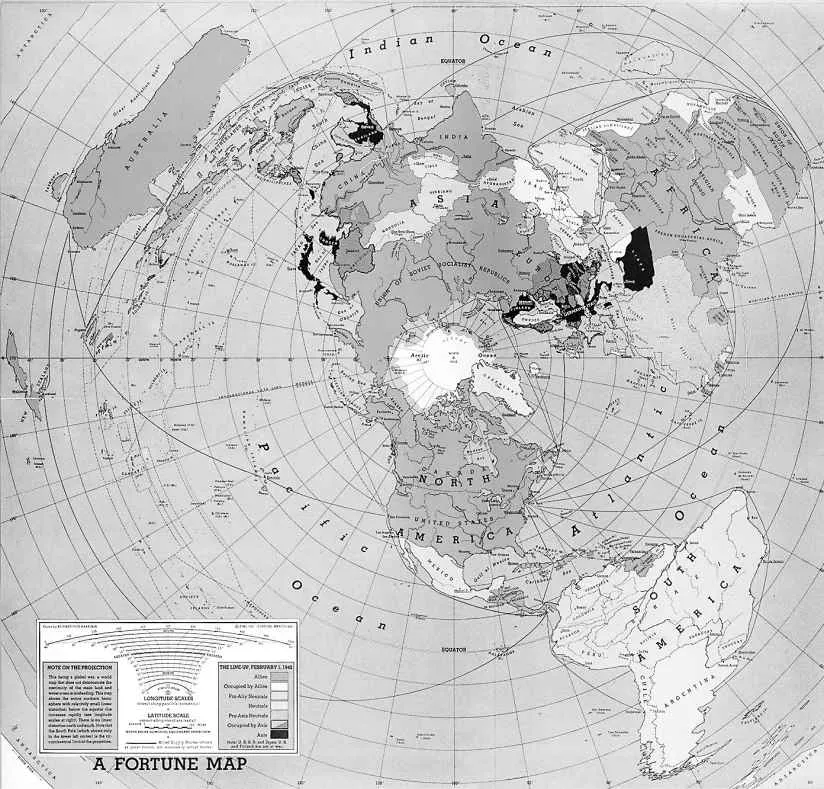 Richard Edes Harrison’s polar azimuthal projection, first published by Fortune in July 1941 and copied widely thereafter (this is a 1942 version). The original accompanying text explained how “the entire conflict pivots around the U.S.” Arrows extending out from New York and San Francisco show the global flow of lend-lease aid.
- The U.S. occupied parts of the Axis powers territories after WWII. In Japan, it was the whole island. MacArthur was assigned to run the occupation. While also being in charge of the military in the Far East, he had control over 80 million people.
When Japanese politicians failed to write a constitution to MacArthur’s satisfaction, he had one drafted, in English, in nine days.
But though it borrowed from the U.S. Constitution and Declaration of Independence, the Japanese constitution was far more liberal, the result of a sort of unchecked New Deal that occupation authorities imposed on the country. The new constitution banned war, prohibited racial discrimination, guaranteed academic freedom, forbade torture, and granted all citizens the right to the “minimum standards of wholesome and cultured living.
Somehow, in the anything-goes atmosphere of the occupation, a twenty-two-year-old Jewish woman named Beate Sirota had made it onto the constitutional drafting committee (she had spent part of her childhood in Tokyo and was one of the few whites who spoke Japanese fluently). It was largely owing to her influence that the constitution mandated equal rights within marriage and prohibited sex discrimination—things that the U.S. constitution conspicuously does not do.
That is still Japan’s constitution today. In more than sixty years, it hasn’t been amended once."
In 1940 its colonized population had made up about 13 percent of the Greater United States. Now, adding it all up—the colonies and occupations—yielded a much larger total. The overseas area under U.S. jurisdiction contained some 135 million people. That was, remarkably, more than the 132 million who inhabited the mainland.
Flag changed to 50 stars after WWII
In 1940 nearly 1/3 individuals on the planet was colonized. By 1965, it was down to 1/50.
Colonized peoples had fought to free themselves and access to arms; U.S. soldiers wanted to go home and held mass protests across the areas they were stationed and sided with guerillas. At home, families of servicemen were also protesting and mailing all their representatives.
Yet even as leaders sought to brush the uprising under the rug, they capitulated to its demands. The men went home, shrinking the army from more than 8 million troops in May 1945 to fewer than 1 million by the end of June 1947—far short of the 2.5 million men the War Department had called for. The army had become, as one official wrote, “a clock running down, losing time, a mechanism without power.
Enough men stayed abroad to occupy Japan and parts of Germany and Austria. But the Korean occupation, which Roosevelt had predicted would last forty years, lasted only three. Truman lamented that “our influence throughout the world, as well as China, waned as the millions of American soldiers were processed through the discharge centers.
That was an exaggeration. The United States still had more ships, planes, and bases than anyone else. But its peacetime army was only the sixth largest in the world. It was in no position to colonize the planet.
Unsure what to do about the Philippines, as the previous independence agreement required that its gov could run itself and protect U.S. interests. But the Commonwealth gov was in exile and lots of other politicians collaborated with the Japanese, and there was a lot of destruction in the Philippines and more than a million dead. There were military reasons to hold the islands, but ultimately Truman gave independence due to the Asian decolonization uprisings in multiple countries leading up to this point
MacArthur backed Roxas despite his collaborating with the Japanese before and reconvened the Phillippine Assembly, where they declared that no one could be held at fault for collaborating with the Japanese. Roxas then turned to killing the Hukbalahap guerillas. He was elected the first president of the independent Philippines
The U.S. Virgin Islands received its first black governor in 1946 and its first native governor in 1950. Guamanians won citizenship and a civil government in 1950, after decades of advocacy. American Samoans remained “nationals” rather than citizens, but they, too, saw naval rule replaced with government by civilians, in 1951.
- Big argument over whether to admit Hawai'i and Alaska as states due to their non-white populations. southerners were worried that they would interfere with Jim Crow. They dragged this out but eventually lost when both were admitted as states in 1959
For racists, this spelled catastrophe—“the beginning of the end of the United States as we have known it,” as Nicholas Murray Butler had put it. In a way, Butler’s prediction turned out to be right. Alaska sent to the Senate Ernest Gruening, who had made a decades-long career of opposing racism and imperialism. In 1964 Gruening achieved national fame as one of only two congressmen—out of 506 voting—to oppose the Gulf of Tonkin Resolution that led to the direct U.S. entry into the Vietnam War. Hawai‘i, for its part, immediately elected nonwhite congressmen: Hiram Fong to the Senate and Daniel Inouye, veteran of the fabled 442nd Infantry Regiment, to the House. Fong was the first Chinese American to serve in the Senate, Inouye the first Japanese American to serve in Congress. Inouye held congressional office in an unbroken stretch from Hawaiian statehood in 1959 until his death in 2012, surpassing even Strom Thurmond’s forty-seven-year record of longevity. By the time he died, Inouye was president pro tempore of the Senate, which put him third in the line of succession to the presidency.
Fong and Inouye proved to be, just as white supremacists feared, champions of civil rights. And had the segregationists gazed farther into the future, they would have been still more troubled by something else taking place in Hawai‘i at the time.
Nineteen fifty-nine was the year of statehood. The next year, 1960, a Kenyan student met a Kansan one in the Russian class at the University of Hawaii. The two married—an interracial marriage illegal in two dozen states at the time—and had a son, who would grow up partly in Hawai‘i, partly in Indonesia. In typical Hawaiian fashion, his profoundly multiracial extended family would grow by marriage to incorporate African American, British, Lithuanian, Indonesian, Malaysian, and Chinese elements. And in 2009 that son, Barack Obama, would become the first black president of the United States.
Muñoz Marín and the PPD (Partido Popular Democrático) didn't support Puerto Rican independence because worries of that retaliatory bill that would hit them with tarriffs, didn't support statehood either. He got elected as Puerto Rico's first governor
"Overpopulation" was seen as a problem by the gov & mainland. Gregory Pincus was allowed to test the birth control on Puerto Ricans and didn't take their complaints about the side effects seriously. Puerto Ricans were also used to test all sorts of contraceptives.
Lots of doctors also sterilized women in the hours after they gave birth. "Of the mothers born in the latter part of the 1920s, nearly half had been sterilized." "Puerto Rico had more women sterilized, by far, than anywhere else in the world."
Muñoz's gov also encouraged women to migrate to the mainland and do domestic work there
Albizu came back from federal prison in 1947. Muñoz passed a Gag Law. Oct 30, 1950, Albizu's liberatory army declared independence and attacked multiple cities at once. Six nationalists tried to shoot Muñoz Marín. He mobilized the PR national guard. Two nationalists on the mainland tried to kill Truman but failed. Mainland news outlets failed to report on the history leading up to this attempt on Truman and made it to be a solo mad case. Muñoz managed to arrest the revolutionary leaders and cement his rule.
Munoz held an election that asked if Puerto Ricans wanted a new constitution. they said yes, and he made a new Commonwealth, which let the U.S. claim PR was self-governing. He claimed this was the PR's consent to the current gov situation (stuck without independence or statehood). Primarily, this let PR be a tax loophole for corporations. PR was still poor but doing better than all of its Caribbean neighbors due to this reform strategy, but it was even more dependent on the U.S.
After the U.N. claimed PR was self-governing, 4 nationalists shot up the House of Reps and hit 5 congressmen. Muñoz arrested Albizu again and confined him till the last months of his life. Despite Albizu's impact, he's never mentioned in U.S. history books.
Stephen Sondheim wrote 2 broadway musicals about Puerto Rico but left out all political background on purpose + made heavily stereotyped stuff. Without knowing a Puerto Rican.
During WWII, the U.S. really needed rubber. For car tires etc., this was an actual problem they were worried about re: the military as well. Germany was also low on rubber which affected their military tactics. The U.S. figured out how to synthesize rubber from petroleum during the war to fix this problem
WWII also brought the beginning of widespread plastic. The military figured out how to synthesize many things to replace supply vulnerabilities from not being able to access tropical trade.
The created replacements are also why the U.S. cared less about giving up colonies after the war. Their materials were no longer direly necessary for national security if the U.S. could synthesize its own. However, most synthetics come from oil, which has made the U.S. contemplate new occupations, tho this hasn't come to be since there is still enough global supply of oil even when prices are high. (Wonder what this author would have to say about the coup of Venezula and the Iran war). Minerals are also harder to synthesize than plants, tho not impossible
Colonial control and the Panama canal. 15,000 or so workers died building it, mostly west indian
Planes really changed everything in WWII when it came to supplies, such as aiding China after Japan closed the Burma road. Supply chains across the Atlantic, Africa, India, Himalayas to China. Planes also allowed attack on Japan without invading its land by foot
1/2 all the cables was owned by the British as they had a hold on latex from Malaya -- until plastic, it was the only material that could effectively insulate deep-sea submarine cables. This let them have secure communication & it could cut off the communication other countries it was warning with needed (like Germany in WW1). Control over telegram cables is also how it intercepted the Zimmerman note (Germany to Mexico offering to help it take back the territory the U.S. had taken from it), which is a big reason why the U.S. got involved in WW1. Encrypted radio changed this and is yet another reason why the U.S. didn't have to keep colonies as the British did, just a few spots in the equatorial area, as did figuring out how to fax images
Other military innovations to replace what Japan had taken over: atabrine and chloroquine for malaria (replaced quinine), DDT for insect control -- blanketed areas by plane to clear disease vectors before military landings... no thought to the ecosystem here though and all the dead plants and animals, sulfonamide-based drugs for bacterial diseases and infections, penicillin.
"The death rate for all disease in the army in World War II was just 4 percent of what it had been in the First World War."
...“amphibious” packaging, made from newly developed materials that could withstand long voyages and exposure to the elements. Plasticized paper, silica gel, sisal, and asphalt featured in these multilayer packages, which portended today’s foil-plastic-paper shelf-stable milk cartons. Burlap sacks were similarly replaced by multiwall sacks of paper, plastic, and asphalt. Tin cans, for their part, could be coated in lacquer or enamel to withstand rust.
The Panama Canal Zone is a telling example. At the start of the Second World War, the United States had been so nervous about losing access to the canal that it established 134 bases in Panama. But at the end of that war, the military had gotten so comfortable moving around the planet without colonies that Harry Truman relinquished all those bases and proposed turning the canal over to the United Nations. Every president after Truman sought to extricate the United States from the increasingly irrelevant Canal Zone in various ways, though it wasn’t until Jimmy Carter’s presidency in the 1970s that a treaty ending U.S. jurisdiction over the zone was finally signed.
Landing plane supplies was also how the U.S. kept its influence in Berlin when Stalin blockaded the area during the Cold War. Eventually, he had to lift the blockade because it hurt him more. The U.S. also beamed radio broadcasts into the USSR & stir up political uprisings. The USSR tried to jam the broadcasts and bomb Radio Free Europe and Radio Liberty in Munich but never managed to cut them completely
Herbert Hoover and measurement standardization
Filipino nursing schools as extensions of mainland colleges. due to the American-centric setup, a large number of Filipino nurses continue to immigrate to the United States today. To the point that Filipino doctors sometimes retrain as nurses to immigrate
Lack of measurement standardization between countries was difficult in WWII (Allies couldn't share equipment); eventually with most of the manufacturing happening in the U.S., its standards became dominant. 60 degree screws rather than Britain's 55. International Organization for Standardization (ISO) - even musical pitches for notes were changed to the U.S. standard. Aviation and traffic signals and signs. Meanwhile the U.S. doesn't even have to adhere to them (see the measurement system)
U.S. reconfiguring Australian farming & shoe industry
Samoset from the Pauquunaukit Wampanoag
English's dominance has largely to do with necessity for global standards, convenience & access to power. English became the standard for aviation and then science and was in entertainment; foreign students coming to study in universities had to learn English; coding and the Internet all prioritize English. It had enough incentives for people to keep choosing it, and at some critical mass it no longer was a choice. Though anti-colonialists in multiple countries tried to phase out English, they ultimately were unable to do so.
English-speaking countries had tried to create ways to make English earlier (like Basic) in hopes of promoting the language globally, but it ultimately wasn't these attempts that popularized it
Even China has University courses taught in English. Some linguist has theorized that even if China became the foremost global power, they'd likely keep English. I wonder about that
English is the language with the most non-native speakers (1 in 4 people on the planet). Meanwhile, Americans don't have to learn any other languages, including our recent presidents
The U.S. mostly forgot about the guano islands after there wasn't much guano anymore, but then they decided to reassert their claims by planting American flags and dropping off teams of 4 Hawaiians to colonize the islands in 1935.
Even when the U.S. supposedly withdraw (like with the Philippines, Japan), it continues to hold military bases on certain islands at 99-year leases. Okinawa is mostly filled with U.S. military. Puerto Rico, Guam, and Hawaii all have military bases in exchange for aid or certain rights
The Great Swan island incident with the Honduras college kids is kind of funny. but geez. Their secret radio transmitter let them broadcast fake news for Guatemala (while organizing a coup) and Cuba. The failed Bay of Pigs invasion was what blew the cover on this island. Also used to train rebels against leftist governments in Nicaragua. Iran-Contra affair
Small islands also became the test sites for the atomic bomb (after the first in New Mexico). Evicted people from the Bikini Atoll/Marshall islands & made them act as if they were happy to leave for film. The bikini swimsuit is named after the islands in reference to the two atomic bombs dropped there shortly thereafter.
"Bravo shot" and killing people outside of the estimated blast zone
Henry Kissinger, the country’s most esteemed civilian nuclear expert, voiced the prevailing attitude in blunter fashion. “There are only 90,000 people out there,” he said, referring to Micronesia. “Who gives a damn?” -- meanwhile the Japanese cared. A lot. See the tuna industry, the petitions, measuring radiation when the U.S. wouldn't, the original JP version of Godzilla, which makes multiple references to these world events
The Japanese were right to be nervous. Despite all the duck-and-cover warnings about Soviet strikes on Cincinnati and Dubuque, the real front lines of nuclear confrontation were the overseas bases and territories. Hundreds of nuclear weapons, we now know, were placed in South Korea, the Philippines, Guam, and Puerto Rico. Throughout most of the sixties, there were more than a thousand on Okinawa. Johnston Island, one of the guano islands Ernest Gruening had recolonized, bristled with nuclear-armed Thor missiles. An unknown number of nuclear weapons were stored in Hawai‘i, Alaska (including on the Aleutian Islands), and Midway.
Thule on Greenland and how the Indigenous Inughuit were forced to move & then nuclear bombs were moved to the base there for better positioning against the Soviet Union. and all the accidents with getting the weapons there (which didn't set off a nuclear accident, but could have)
Burtonwood base in Britain which both spurred anti-war and anti-nuclear protests as well as made a thriving music scene in Liverpool from the access to records, particularly those by African-Americans (eventually giving rise to the Beatles, etc.). Later the Beatles joined these anti-war protests. As the book says, Those who lived in the shadow of the bases both resented them and built their lives around them, vacillating between protest and participation.
Bases on Japan under the dictatorship of MacArthur and the dangers it brought to populations near them, accidents, murders by soldiers, rape, etc. and in the early years Japan didn't have the jurisdiction to prosecute
U.S. was major employer in Japan at the time and made a lot of purchases to supply its war in Korea & Vietnam. A lot of its economic power afterwards is thanks to this. Why is basically all global economics profiting off of someone else's war?? Off the torture & dead bodies of people???? ugh
The U.S. military was the largest and one of the most exacting standard-setting agencies on the planet. Producing for it was like having a well-paid internship: lucrative in the moment but also conferring skills that would prove extremely valuable later.
It is telling that one of the visitors from the United States whom the Japanese held in the highest regard was a statistician named W. Edwards Deming. He’d worked in logistics during the Second World War, and his specialty was quality control—techniques for ensuring that industrial products were built to specification (the Total Quality Management movement derived in part from his ideas). None of this earned him much renown in the United States, but he was, as they say, big in Japan. Engineers there flocked to his lectures, read his works, and signed up for courses from him. “I never felt so important,” Deming remembered. He received a medal from the emperor.
Was this because Deming was a genius? Probably not. It didn’t take Japanese engineers long to absorb what he knew and surpass it. Deming was famous, rather, for what he stood for. As one of Sony’s founders put it, he was the “patron saint” of quality control in Japan. In a dependent economy, where so much hung on winning military contracts and adhering to standards, that was the saint who was prayed to the most.
^ this is all pretty funny when you think about how much of "why are things in Japan so high in quality" explainers are like Le Japanese Culture & not the requirements of being occupied & to stay competitive. U.S. companies can afford to skimp on quality & they have tariffs on their side as the largest economic power if others are competing too hard against them.
1959-60 Japan protests against U.S. protests. "Japan renewed its basing agreement, yet the toll this took on its government was evident. The day the treaty was signed in 1960, the prime minister announced his resignation. The next month, a protester stabbed him six times in the leg."
1970 Japan protests again U.S. bases. In the face of the protests, the United States returned Okinawa to Japan in 1972. But it kept the bases. Today, 20 percent of the island is used by the U.S. military.
- Totsuko & tape recorders that used magnetized paper rather than plastic. First places they were sold were to school to have japanese translations accompany the English videos that the U.S. had sent over for education (without any TLs). This company then rebranded to Sony.
Economists call it a “first-mover advantage.” But that advantage subsides with time. Once everyone uses 60-degree screw threads, there’s no benefit to having been the first one to have used them (though there may be other rewards for having gotten ahead of the learning curve). The longer the race, the less meaningful a head start is.
...
Once other countries mastered U.S. standards, they too could profit and even compete with the United States itself. It is telling that the countries hosting the most U.S. peacetime bases—such as Britain, Japan, West Germany, and South Korea—numbered among the United States’ most formidable competitors.
Well. This truly only applies as long as the U.S. isn't constantly trying to overthrow your government like it does with Latin America (and other places.)
- U.S. protests against Japanese goods (like automobiles) outcompeting them, racial violence. Akito Morita, one of the founders of Sony, went on to author a nationalist book with a right-winger about being able to resist the U.S. & refused to have it translated
Dhahran military base, closed initially in 1962 to protests. Osama bin Laden's father worked there and learned the construction trade. Saudi Arabia (& the U.S.) helped fund the mujahidin resistance against the 1978 communist Afghanistan coup (which was supported by the USSR). Bin Laden brought over his construction equipment from Saudi Arabia & ran a mujahidin base in Pakistan. The USSR lost this war (not that al-Qaeda had a big part, though).
1990 Saddam Hussein (Iraq) invaded Kuwait. Saudi Arabia looped in the U.S., in exchange for reopening Dhahran, because they were worried about being invaded next. "Measured in ton-miles per day, the airlift to Saudi Arabia was ten times the size of the Berlin Airlift." Bin Laden joined in the fight because he's opposed to Iraq's secularity.
Operation Desert Storm was successful due to new GPS technology + "smart" bombs + infrared tech to locate Iraqi tanks hidden in sand.
The Russian military theorist Vladimir Slipchenko noted that the very spatial categories of war were changing. In the future, he suggested, area-based military concepts such as front, rear, and flank would be irrelevant. There would be only “targets and non-targets.” Further, Slipchenko predicted, “there will be no need to occupy enemy territory.” Controlling territory wouldn’t matter, because war was no longer about area. It was about points.
- Bin Laden was mad about the U.S. military staying past the Gulf War. He moved to Afghanistan at the urging of the Saudi government. Bombs start going off and Dhahran.
In search of security, the air force issued a contract for a $150 million compound in a remote location in the Saudi desert. “You can see something coming for miles,” the spokesman explained. It was to be a military oasis, with forty-two hundred beds and eighty-five buildings, including a dining hall, a gym, a swimming pool, and a recreation facility. What was most remarkable, though, was the builder that the Saudi government hired to erect the base: the Bin Laden firm.
If there is one episode that perfectly captures the dual nature of the U.S. basing empire, it’s this one. Participation and protest—the Beatles and the peace sign, Sony and the Okinawa riots—braided within a single family. The Bin Ladens built the bases. A Bin Laden would seek to destroy them.
Bin Laden declares war in 1996 and uses satellite phone technology to coordinate strikes on U.S. embassies in multiple countries. Clinton orders strikes on al-Qaeda bases in Afghanistan & a random pharmaceutical company in Sudan believed to be making chemical weapons (there was no evidence of this). Bin Laden was not at any of the bases. The 9/11 plane hijackings/crashes likewise did not require ground forces. One of the biggest reasons for Bin Laden's strikes was retaliation for U.S. military bases.
Was banking on a U.S. to enter a quagmire war with 9/11 strikes. Bush initially does a "network" war that doesn't involve a lot of ground troops. Started using drones.
Various protests & shuttering of certain bases on Hawai'i, Philippines, Puerto Rico, Saudi Arabia, Uzbekistan, Kyrgyzstan, led the U.S. to focus more on Guam in the Pacific, where they weren't beholden to any government & gave them no representation.
Loopholes to torture: Fly prisoners to other countries that allow torture. Or Guantánamo Bay, which was taken from Cuba. This went to the Supreme Court in 2004, which ruled that Guantánamo detainees could actually seek justice in federal courts.
Likewise loopholes to slavery: Move poor Chinese, Filipino, and Bangladeshi workers to places like Saipan, part of the Commonwealth of the Northern Mariana Islands, which are like Puerto Rico in that the inhabitants are conditional citizens without full protections (such as to labor laws). The garment industry on Saipan gets to write "Made in the USA".
Jack Abramoff, a lobbyist who bought off congressmen (through special trips to Saipan) to let the U.S. keep these loopholes. Also defrauded Indigenous communities who tried to hire him too. He was eventually taken down by McCain, which is also what made him a popular candidate for presidency.
Comparison of McCain and Obama's birthrights: Obama in Hawai'i, which is a state; McCain in the Panama Canal Zone, which is a territory, and 1 year before the law that allowed citizenship for the children of any citizen in that area. (Palin also was married to a Yup'ik man who was part of the Alaskan Independence Party, which sees Alaska as a colony.) Does being born in a territory count for presidency? And yet the birthright question only ever came up for Obama because racism. Specifically the suspicions of his birth certificate are what let Trump become a big name in politics.
You might see the intrusions of colonialism into recent politics as a sort of hangover—a price paid for yesterday’s excesses. In this view, empire is an affair of the past, even if its effects linger on.
But empire is not yet past. In August 2017, North Korea, eager to demonstrate its destructive power but unable to reliably reach the U.S. mainland with its missiles, threatened to create “an enveloping fire” around Guam, which the United States uses as a launchpad to fly B-1 bombers over the Korean Peninsula. Yet again, it seemed that a territory might become a military sacrifice zone, and yet again the mainland press showed more concern for the fate of the troops stationed there than for the colony itself. “Guam is American soil,” its governor nervously reminded. “We are not just a military installation.”
The next month, Hurricane Maria slammed into Puerto Rico, taking out the island’s power grid, water system, and communications. It also exposed the parlous state of affairs in the United States’ largest remaining colony. Although Luis Muñoz Marín’s strategy of using tax loopholes to draw mainland corporations to the island had dramatically improved Puerto Rico’s economy in the 1950s and for decades after, Congress removed those loopholes in the 1990s, triggering corporate flight, economic collapse, and an exodus of employable Puerto Ricans to the mainland. By the time Maria struck, more than 60 percent of the island’s remaining inhabitants were on Medicare or Medicaid. Because the federal government funds those programs less generously in Puerto Rico than on the mainland, the commonwealth found itself accruing unsustainable debt to pay its bills.
The hurricane turned crisis into catastrophe. Puerto Ricans were knocked back a century as they made do without phones or electricity. Doctors were forced to perform surgeries by flashlight, city dwellers to search desperately for clean water. Hurricane Maria struck at nearly the same time as two other storms hit the mainland, Hurricane Harvey in Texas and Hurricane Irma (which also struck the U.S. Virgin Islands) in Florida. The difference in response was palpable. Though Puerto Ricans were far more likely to die from storm damage, they saw fewer federal personnel, markedly less media coverage, and only a fraction of the charitable giving.
“Recognize that we Puerto Ricans are American citizens,” the island’s governor pleaded. Yet a poll taken after Maria found that only a slight majority of mainlanders (and only 37 percent of those under thirty) knew that fact.
There are about four million people living in the territories today, in Puerto Rico, Guam, American Samoa, the U.S. Virgin Islands, and the Northern Marianas. They’re subject to the whims of Congress and the president, but they can’t vote for either. More than fifty years after the Voting Rights Act, they remain disenfranchised. As Guamanians and Puerto Ricans have recently seen, this disenfranchisement carries potentially lethal consequences.
Empire lives on, too, in the overseas bases that dot the globe. It’s easy to think of foreign policy as an affair of the negotiating table: sovereign nation-states sit down to threaten, bargain, or cooperate. But U.S. foreign policy, nearly uniquely, has a territorial component. Britain and France have some thirteen overseas bases between them, Russia has nine, and various other countries have one—in all, there are probably thirty overseas bases owned by non-U.S. countries. The United States, by contrast, has roughly eight hundred, plus agreements granting it access to still other foreign sites. Dozens of countries host U.S. bases. Those that refuse are nevertheless surrounded by them. The Greater United States, in other words, is in everyone’s backyard.
So does all this mean the United States can be classified as an empire? That term is most often used as a pejorative, as an unfavorable character assessment. Empires are the bullies that bat weaker nations around. It’s not hard to argue that the United States is imperialist in that sense. Certainly its corporations and armed forces have spread themselves out comfortably all over the world.
Yet empire is not only a pejorative. It’s also a way of describing a country that, for good or bad, has outposts and colonies. In this sense, empire is not about a country’s character, but its shape. And by this definition, the United States has indisputably been an empire and remains one today.
Oddly, though the United States is frequently accused of imperialism, its territorial dimensions go largely unnoticed. So much energy has gone into presenting the United States via the logo map that even its critics, the ones most eager to cry empire, have little to say about overseas territory.
Still, if there is one thing the history of the Greater United States tells us, it’s that such territory matters. And not only for the people who live in colonies or near bases. It matters for the whole country. World War II began, for the United States, in the territories. The war on terror started with a military base. The birth control pill, chemotherapy, plastic, Godzilla, the Beatles, Little House on the Prairie, Iran-Contra, the transistor radio, the name America itself—you can’t understand the histories of any of these without understanding territorial empire.
Territory still matters today. Colonialism hovers in the background of politics at the highest level. McCain, Palin, Obama, and Trump have all been touched by it. That may seem like an odd and surprising fact. But we should get over our surprise. The history of the United States is the history of empire.
Idk zebra I think empire is pretty unequivocally bad and you don't need to pull your punches like that. Controlling a territory instead of treating them as an equal part & only allowing dogshit representation in gov? Yeah that fucking blows if you believe in democracy at all. ¯\_(ツ)_/¯